

Today’s workplace is more “connected” than ever.
But being constantly connected to work doesn’t necessarily mean we’re connecting with the people we work with.
Even in a traditional office, coworkers can spend most of the day focused on individual responsibilities, deadlines, emails, messages, meetings, and screens. We may work beside the same people every day without having many opportunities to communicate outside our normal roles, solve something together that isn’t on a task list, or simply get to know one another beyond the job.
That’s part of what makes intentional time together so valuable.
A well-designed team-building experience interrupts the normal routine. It takes people away from their desks, titles, inboxes, and familiar workplace patterns and gives them something different to navigate together.
And when that experience happens outdoors, the change is even more complete.
Instead of moving the team from the office conference room to a hotel conference room, you’re putting them into a completely different environment—one where they can move, communicate, problem-solve, laugh, and experience something together.
And When Your Team Is Miles Apart?
For hybrid and remote teams, that intentional time together can become even more important. Coworkers who once spent five days a week in the same workplace may now see one another only occasionally—or may work together every day without ever occupying the same physical space.
Hybrid work has become a predominant arrangement among remote-capable employees in the United States, and workplace research from Gallup has highlighted collaboration, relationships, and team culture as areas organizations need to cultivate intentionally when employees aren’t together every day.
Technology makes it possible for those teams to work together remarkably well across distances. But a video call can’t replicate every part of being together.
Bringing a distributed team into the same place gives coworkers opportunities for the informal conversations, shared experiences, spontaneous interactions, and face-to-face problem-solving that are much harder to create through scheduled calls and messages.
If intentional connection matters when employees are separated by desks, departments, and screens, it can matter even more when they’re separated by miles. That’s where a company retreat can become more than a break from work. It can be an opportunity to reconnect the people doing the work.

Connection Doesn’t Happen By Accident
A group of employees isn’t automatically a connected team simply because they work for the same company.
Sometimes teams need intentional time together.
And that time doesn’t necessarily need to revolve around another conference table.
Shared experiences give coworkers an opportunity to interact outside their usual roles. The person who leads the weekly meeting may not be the person who sees the solution to an unfamiliar challenge. A quieter team member may suddenly become the clearest communicator. Someone who rarely works with another department may discover that they make a surprisingly good team.
Those moments give people an opportunity to learn something about one another that may never surface during an ordinary workday.
Take Your Team Out of the Office—Literally
There’s value in simply getting a team out of its normal environment. But taking that team outdoors adds another dimension.
Research into nature exposure has increasingly found associations with reduced stress and improved psychological well-being. That doesn’t mean a walk through the woods will magically solve workplace problems—but it does give us good reason to think that where we spend our time matters.
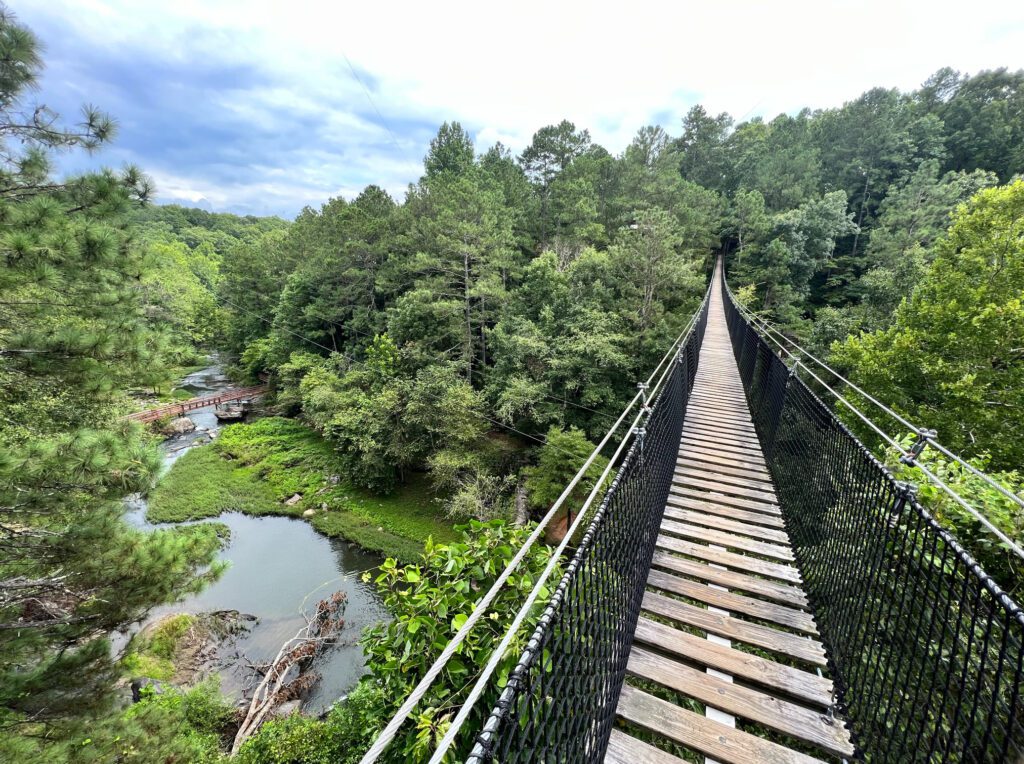
At Historic Banning Mills, stepping away from work really does mean stepping away. More than 300 acres of forest, the rugged Snake Creek Gorge, flowing water, historic ruins, trails, and suspension bridges replace cubicles, screens, traffic, and office noise.
Nature isn’t simply the backdrop for the retreat. It’s part of the experience.
An Activity Isn’t Automatically Team Building
Put ten coworkers on a zip line together and they’ll have a memorable day. But that alone doesn’t necessarily make it team building.
Effective team building starts with a purpose. Maybe a team needs to improve communication. Maybe a new group needs to learn how to work together. Maybe leadership wants to strengthen trust, encourage collaboration, identify different problem-solving styles, or simply reconnect people who rarely spend meaningful time together.
That’s where facilitated team building is different from simply booking a group activity.
At Historic Banning Mills, team-building programs can be designed around the needs and goals of the group. Facilitated challenges create situations where participants have to communicate, listen, plan, adapt, problem-solve, and work together.
That doesn’t mean team building shouldn’t be fun—it absolutely should be. Laughing together, trying something new, and enjoying the experience are part of what makes it memorable. But when team development is the goal, there should also be intention behind the activity.
A Little Challenge Can Reveal a Lot
Give a team an unfamiliar problem and watch what happens.
Who speaks first? Who listens before acting? Who asks questions? Who notices the person who hasn’t said anything yet? What happens when the first idea doesn’t work? Does the group adapt—or keep trying the same thing?
Those behaviors can be difficult to recognize when everyone is sitting around a conference table discussing them theoretically. The challenge creates the experience. The debrief helps turn that experience into something the team can take back to work.
The goal isn’t to determine who’s “best” at the activity. In fact, the activity itself isn’t really the point. The value comes from the process—and from giving the team an opportunity to reflect on what happened and how those same patterns may appear back at work.
Our facilitators help groups recognize what happened, why it happened, and where similar patterns appear in their workplace.

Your Team Needs Something to Talk About Besides Work
Not every benefit of bringing a team together needs to come from a structured exercise.
Shared experiences become shared stories.
The challenge nobody could solve at first. The coworker who surprised everyone. The person who was terrified to try something and did it anyway. The moment Plan A failed spectacularly and everyone dissolved into laughter.
Those experiences give coworkers something in common that has nothing to do with deadlines, departments, or job titles.
You can’t manufacture friendship during a corporate retreat. But you can create opportunities for people to know one another as people.
Challenge Doesn’t Mean Intimidation
Outdoor team building doesn’t have to mean climbing high into the trees or convincing everyone in the office to step off a platform.
Every team is different, and so are the ages, abilities, personalities, and comfort levels of the people within it. A good team-building program should take those differences into account.
At Historic Banning Mills, outdoor team building can range from ground-based initiatives that require very little physical challenge all the way to high ropes experiences. Your team can get outside, work together, and benefit from a completely different environment without turning the day into a full-on adventure experience.
For some groups, the right challenge may involve communication and problem-solving with everyone’s feet firmly on the ground. Others may be ready to take those lessons higher—literally.
The goal isn’t to find the most intimidating activity everyone can survive together. It’s to choose experiences that support what your team is actually there to accomplish.
What Should You Look for in a Team-Building Program?
Purpose. What do you actually want the team to work on?
Professional facilitation. Who is leading the experience, and are they trained to connect the activity to team development?
Appropriate challenge. Can activities accommodate different abilities and comfort levels?
Time to reflect. Is there a facilitated debrief rather than simply moving from activity to activity?
Don’t Just Plan Team Building. Build a Retreat.
Sometimes the greatest value comes from simply giving a team time together.
At Historic Banning Mills, groups can combine facilitated team development with meeting space, meals, lodging, and outdoor recreation—all on one property.
Hold a strategy session in the morning. Move outside for facilitated team building in the afternoon. Sit down together for dinner without everyone rushing home afterward. Stay overnight and spend the next day zip lining, hiking, exploring the property, or taking on another adventure together.
That creates room for both structured team development and unstructured connection.
And the conversations that happen over breakfast, walking between activities, sitting around after dinner, or encouraging a coworker through an adventure may be every bit as valuable as what happens during the scheduled session.

Everything Your Group Needs in One Location 
Team Building Options 
Unique Lodging Options 
Meeting Spaces 
Adventure Options
What Does Your Team Need?
There’s no single activity that can magically transform a group of coworkers into a high-performing team.
But getting people out of their normal routines can create space for something that’s increasingly difficult to find during the workday:
Time to communicate. Time to connect. Time to solve problems together. And time to simply experience something together.
That’s what outdoor team building can offer when it’s done with purpose.
At Historic Banning Mills, we work with companies, organizations, schools, churches, and other groups to create experiences based on their goals, group dynamics, and comfort levels—from facilitated team-building programs and meeting space to lodging, meals, and outdoor adventures.
Because sometimes the most productive thing you can do with your team is get them away from work for a while.
Start planning your perfect group experience!
